

A shower head doesn’t fail all at once. It just gets a little weaker every month, the spray goes from a strong even pattern to a sad, sideways dribble, and you don’t really notice until a friend uses your shower and asks what’s wrong with it. That’s mineral buildup slowly clogging the tiny holes from the inside.
The fix is almost entirely vinegar and patience, with one sharp tool for the stubborn holes. Here’s the order that actually restores full pressure. (For the rest of the bathroom, our easy bathroom cleaning schedule hacks guide covers everything else worth keeping on a routine.)
What you’ll need
- Distilled white vinegar
- Baking soda (optional, for grime beyond just minerals)
- A quart or gallon-size ziploc bag
- A rubber band, zip tie, or tape
- A soft toothbrush or nylon brush
- A sewing needle, straight pin, or paper clip
- An adjustable wrench and pliers, only if the head is stuck or won’t unscrew by hand
The quick method: soak it without removing it
If your shower head doesn’t unscrew easily, or you just want a quick refresh, you don’t need to take anything apart. Pour about a cup of distilled white vinegar into the ziploc bag, slip the bag over the shower head so it’s fully submerged, and secure the top with a rubber band, zip tie, or tape.
For routine monthly maintenance, 30 minutes is enough. If it’s been longer than that since the last clean, Home Depot recommends leaving the bag in place overnight, around eight hours, then running the hot water at full pressure to flush out the loosened deposits.
Adding baking soda, if you want more than just descaling
Vinegar alone handles mineral deposits. If there’s also organic grime and soap residue mixed in, baking soda helps break that down too, since it’s a base reacting against vinegar’s acid. Bob Vila’s cleaning guide is specific about the ratio here: no more than 1 part baking soda for every 2 parts vinegar. Use equal amounts of each and they’ll just neutralize each other, which defeats the purpose.
The deep clean: remove the head and soak it properly
Heavier buildup, reduced pressure for months, or a home you know has hard water all call for actually taking the shower head off.
Most unscrew counterclockwise by hand. If yours is stuck, wrap it in a rag first to protect the finish, then use a wrench while holding the arm steady with pliers so you’re not twisting the pipe itself. Once it’s off, wipe out any visible debris from the threaded interior, and if there’s a small filter screen inside, pull it out gently with tweezers or needle-nose pliers and rinse it separately.
Submerge the whole head in a bowl of distilled white vinegar, deep enough to fully cover it, and let it sit for at least an hour, up to overnight for anything badly clogged.
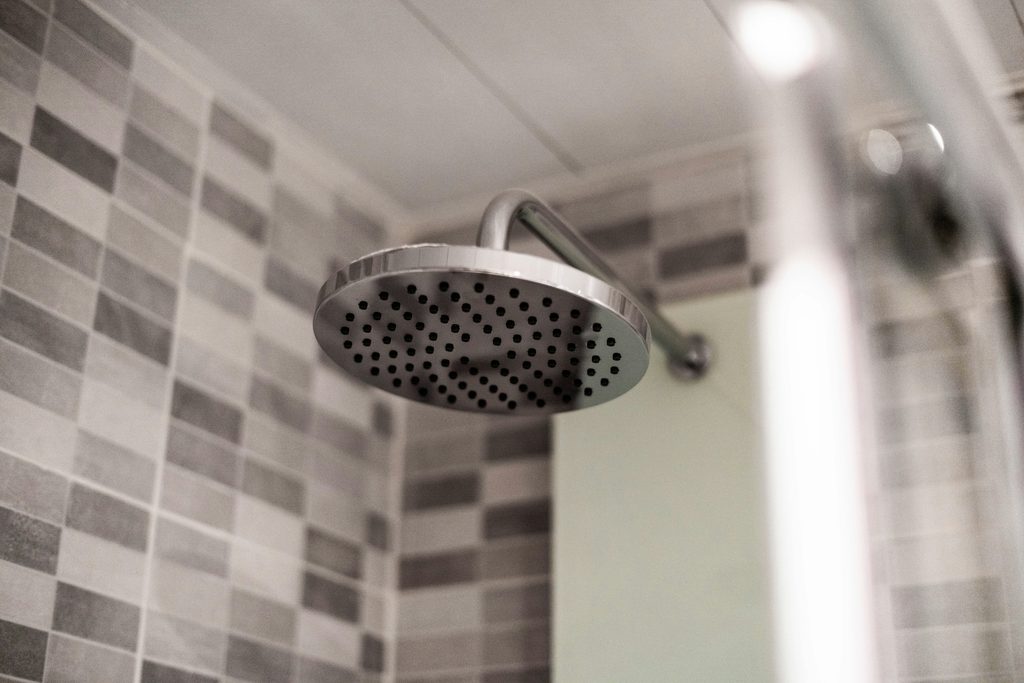
Photo by kevin Baquerizo on Unsplash
Clear the individual holes
This is the step that actually brings pressure back, and it’s also the one people skip. After soaking, most of the deposits will rub off with a soft toothbrush. But individual nozzle holes often stay partially blocked even after a long soak, and the only real fix is pushing a sewing needle, straight pin, or straightened paper clip through each one by hand.
It’s tedious. It’s also the difference between “better” and “like new.”
One caution before you reach for a commercial cleaner
If plain vinegar isn’t cutting it and you’re tempted by a store-bought descaling product, check the label against your shower head’s finish first. Bob Vila flags this specifically: some rust and lime-deposit removers, along with toilet bowl cleaners, will permanently mar chrome. A cleaner that’s fine on tile isn’t automatically fine on metal plating.
Reassemble and test
Put the filter screen back where it was, screw the head back on by hand as tight as you can manage, and only use a wrench for the final bit if needed, again with a rag protecting the finish. Run the shower at full pressure for a minute to clear out any last residue before you actually use it.
How often this needs to happen
Roughly every one to two months if you have hard water, based on the general guidance from cleaning retailers like Bob Vila and Home Depot. If your water is particularly hard, or you notice the spray weakening faster than that, there’s no harm in doing the quick bag-soak method more often. It’s a 30-minute task either way.
Keeping buildup from coming back
Wipe the outside down regularly. Spraying the exterior with vinegar and wiping it as part of your normal bathroom cleaning keeps surface deposits from hardening in the first place.
Do a monthly bag soak even before you notice a problem. Thirty minutes once a month is a lot less effort than an overnight soak and a sewing needle every six months.
Consider a water softener if this keeps happening fast. If you’re cleaning the shower head more than every month and it’s still clogging, that’s less a cleaning-routine problem and more a hard-water problem. A whole-home water softener addresses it at the source, and it extends the life of your dishwasher and washing machine too.
Products that make this easier
| Category | Volume (per year) | Frequency | Essential items | Deal |
|---|---|---|---|---|
| DIY Descaling Soak | ~10 bottles | Monthly | White vinegar, baking soda, ziploc bag, rubber band or zip tie | 🛒 View deals |
| Soft Cleaning Brush | 1–2 replacements | As needed | Soft toothbrush or nylon cleaning brush | 🛒 View deals |
| Unclogging Tool | 1 pack | As needed | Sewing needle, straight pin, or paper clip | 🛒 View deals |
| Removal Tools | 1 set | As needed | Adjustable wrench, pliers | 🛒 View deals |
| Commercial Descaler | 2–3 bottles | As needed | Shower head mineral deposit remover (finish-safe) | 🛒 View deals |
Some links on this page may be affiliate links. If you purchase through one of these links, we may earn a small commission at no additional cost to you.
Questions people ask
Can I use regular vinegar, or does it need to be the cleaning kind?
Regular distilled white vinegar from the grocery aisle is what most guides actually recommend. Cleaning vinegar is stronger, around 6% acidity versus the usual 5%, but that extra strength isn’t necessary here and can be too harsh for delicate finishes.
What if my shower head doesn’t unscrew at all?
The bag-and-rubber-band method works without removing anything. It’s slower to get to the inside of a severely clogged head, but for most buildup it gets the job done without any tools.
Is mold on a shower head a different problem than mineral buildup?
Yes. Mineral deposits are white and chalky, mold is usually darker and fuzzier in texture. Vinegar does fine against light mold, but a dedicated mold and mildew remover is a better call if you’re seeing actual mold growth rather than scale.
Will this work on a handheld shower head too?
Yes, the same bag-soak and deep-soak methods both work on handheld heads. If it detaches from its hose, you can even submerge it directly in a bowl instead of bagging it.
Bottom line
Hard water buildup in a shower head is almost always fixable without buying a replacement. A vinegar soak loosens the minerals, a needle clears the individual holes that soaking alone won’t fix, and a monthly 30-minute soak keeps you from ever needing the overnight version again. If you’re doing this every few weeks no matter what, that’s a sign the water itself is the problem, not your routine.
Looking for more ways to keep the rest of the bathroom on a routine? Check out our full easy bathroom cleaning schedule hacks guide.